

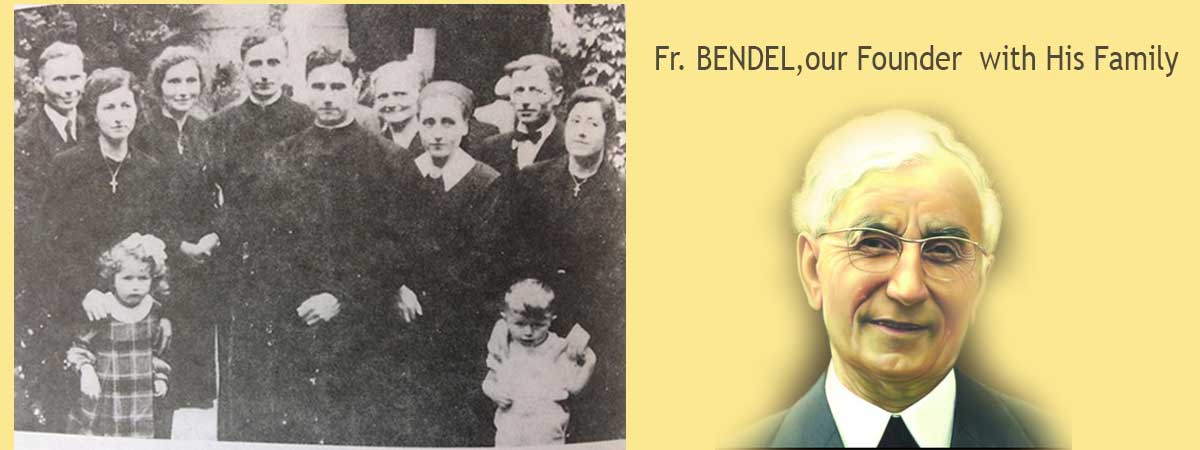
Fr. Bernhard Bendel
Bernhard Bendel was born on 20th October 1908 in the little village of Steinefrenz in the Westerwald District. Steinefrenz lies in the middle the towns of Limburg, Lahn and Montabaur, in the state of Hesse in Germany. Bernhard's father, Heinrich Georg Bendel, and his mother Katharina (née Michel) were prominent Catholics and faithful parishioners of the Steinefrenz Parish in the Diocese of Limburg.
The period before World War I (1914-1918) was a golden time in Germany, a time of economic development, which came about in the years after 1871. However, the villages of the Westwald had experienced little of this upswing. There the life of the farmers continued to be hard and difficult. The Bendel family, including the grandparents and children, had to work hard in order to make a living from their small, narrow fields. The fields were narrow because of the peculiarities of the inheritance laws in the former duchy of Nassau. Moreover, the soil of the place was volcanic and not very fertile. Thus people of the area grew up accustomed to working hard and living modestly. At the same time these people were trustworthy, sincere and above all deeply anchored in their Christian faith, a faith that provided not merely a decoration for certain family festivities, but was also an integral part of their daily lives.
Bernhard Bendel attended elementary school in Steinefrenz for eight years. Then he studied Latin for three years, since knowledge of Latin was a precondition for acceptance in the higher school, the gymnasium, which, in turn, was a prerequisite for admittance to the university. However, instead of the gymnasium, Bernhard, at age fourteen, opted for the diocesan minor seminary in Hadmar.
Life in the Seminary
The minor seminary was a six-year boarding school which culminated with the completion of the abitur,--a comprehensive exam marking graduation from high school,--which Bernhard achieved in 1928. At the seminary, he built strong friendships which lasted the rest of his life.
He was a bright and popular student and a good athlete as well. His excellent grades in his final examinations, especially in mathematics and physics, led to tempting offers from industries. However, already sure that his vocation was to become a priest, he gave up the prospect of a lucrative career to enter the major seminary.
His Philosophy and Theology studies were done at the Jesuit college of St. Georgen in Frankfurt am Main. He received financial support from the diocese in the form of an interest free loan. The years from 1928 to 1933, while Bernhard was studying in Frankfurt, were years of great consequence for many. In government, communists and Nazis were vying for power. In the Church, these years and those that followed, although turbulent, were times of Catholic activism and there was an upsurge in vocations for the priesthood and religious life.
At St. Georgen College, Bernhard was attracted to the religious life that he experienced there but he did not feel called to Jesuit spirituality. Nevertheless, he respected and spoke about his professors with high esteem. After his theological studies he received minor orders in May 1933, on July 25 he became a sub-deacon and on July 30, 1933, a deacon at the oratory of St. Georgen. On December 8, 1933 he was ordained a priest in the cathedral of Limburg by his bishop Antonius Hilfrich. Two days later he celebrated his first solemn mass of Thanksgiving in his village parish church. This was the year Adolph Hitler seized power in the country.
Soon after his priestly ordination, he knew the time had come to bring forth the harvest that had been nurtured during his years of studies. As a young priest he was soon confronted by the challenges of the Hitler regime. This meant to profess publicly his Christianity and to prove himself the yeast of the Gospel and the leaven for the world.
Bernhard's Work, 1934-1950
Bernhard was a student during the Weimar Republic from 1919 to 1933; years shaped by the German defeat during World War I (1914-1918) and the humiliations at the hand the allies in the Versailles Treaty (1919). The difficulties of this period played a role in the rise of the right wing NSDAP, Adolf Hitler's Nazi Party. It was also a time of continuing economic upheaval and a time of violence, frequently instigated by the left wing communists. All this led Adolf Hitler and his party to seize power on January 30, 1933 thus beginning the worst dictatorship in history.
Bernhard's first appointment as a priest on March 21, 1934 was as vicar in Bad Schwalbach. Two years later he became chaplain in Geisenheim/Rheingau, and in 1937 he was appointed associate pastor of Schramn in Neuenhain, with all the rights and duties of a pastor. In 1940, he was made chaplain in Hattershein with the filial parish, Okriftel. That same year, Bishop Hilfrich appointed him curate for Mammolshain/Taunus, with pastoral responsibilities at the children's sanatorium in Mammolshain. He remained in Mammolshain for the rest of his priestly life, first as parish curate and later as pastor.
Father Bernhard was officially summoned several times by the Gestapo (the Secret Police founded to fight against internal resistance), first on May 18 and again on June 3, 1942, in Frankfurt to answer questions because of his activities, and was given stern warnings. However, he was not discouraged and continued to preach and bear witness to his Christianity even when it conflicted with Nazi practice and theory.
When the war ended in 1945, most of Germany experienced the end of the war as liberation. But because of the total surrender on the part of the Germans, difficult times were to follow. After the war, Germany was confronted with the work of reconstruction. Fr. Bernhard's efforts were directed to the construction of a new church at Mammolshain, from October 1946 to October 1948. He believed that the presence of the church was the sign of a better life and a future. For him, building a new church was a way to give hope to the people and to show them they were moving forward into the future even if much had been destroyed. In this way, he gave new courage to all the people in his parish whom he loved and knew by name. He was a serious pastor, devoted to his people.
Bernhard’s Work 1950-1980
Towards the end of 1949, the Vicar General of Limburg Diocese, Dr. Georg Hohle, on behalf of the bishop asked Father Bernhard Bendel to found a Community of Sisters who could be trained for the apostolate in Mammolshain. As he deliberated on this invitation, he sought the advice of his confessor, who supported the proposal. During the Holy Year 1950, Fr. Bernhard made a pilgrimage to Rome, for the beatification of Vincent Palloti, the founder of the Catholic Apostolate. Through the Schönstatt movement, he was already acquainted with Palloti's spiritual thought. While he was in Rome, he prayed at the tomb of the Apostles for the gift of enlightenment concerning his bishop's request. He also visited Assisi. As soon as he was back in Germany, the bishop approached him again and this time Bernhard consented to establish sister came to Mammolshain. From that day on, Fr. Bendel worked entirely toward the development of the Opus Spiritus Sancti (OSS). In 1953, he undertook to organize a few priests who had shown interest in the community of the Holy Spirit. The bishop accepted the idea and gave his approval. This group was for diocesan priests only, since there had been much isolation, loneliness and frustration among priests during and after World War II. The group provided an opportunity for priests to come together, to pray, to discuss their problems, and to help each other.
As the project began to flourish and engage more and more of his energies, Father Bernhard was released from parish work in 1957, and was given an assistant, so as to dedicate himself more fully to developing the communities that had been started. During this time, he had many things to do, many of which were outside of Germany. He was invited by bishops from America, Africa and Asia. He went to America, the Diocese of Sioux City, Iowa, in 1957, to Africa, Morogoro Diocese, Tanzania, in 1960, and to Kerala, India in 1968. From January 1969 onwards, he made annual trips to each place to give retreats, to continue developing contacts and to strengthen the Opus Spiritus Sancti communities.
On April 21, 1950, the first three sisters
Apart from the Holy Spirit Sisters community there are now four other communities, which came into existence spontaneously, without a pre-existing plan: in 1950, the CAC (Christian Apostolic Community),--a group of lay Christians who come together to pray with the Sisters,--and in 1952, the Secular Institute of Priests (SIP), diocesan priests who join the community of Sisters to invoke the Holy Spirit. The latter group usually meets once a month, and although they are members of the OSS, they still work with their appropriate dioceses, meeting periodically for prayer and sharing. 1954 saw the birth of the community of the Secular Institute of Women (SIW),--unmarried women who join the Sisters for prayer and fellowship. In 1974, the last community, the Apostolic Life Community of Priests (ALCP), was founded. This last group came about due to the felt need of the founder and the other communities to have a missionary community of priests who would take charge of other communities. Fr. Bernhard Bendel made his dedication as the first member of the ALCP/OSS that same year. On December 1, three other candidates made their dedication.
While the Opus Spiritus Sancti communities were still flourishing especially in Africa and India, Father Bernhard became sick and died on January 19, 1980. Father Karl W. Bruno became his successor. After the death of the founder, and thanks to the good foundation which he had laid, the communities of the Opus Spiritus Sancti have continued to prosper even up to the present day.
Fr. Bednel: A Personal Record
- 1908 Born on October 20, as legitimate son of the married couple Heinrich George Bendel and Katharina Bendel, nee Michel, in Steinefrenz/ Westerwald, Diocese of Limburg
- 1915-1921 Primary education in Steinefrenz and at the same time preparation for the secondary education by the then Pastor of that parish, Alois Wolf.
- 1922-1928 Secondary education (Humanistishe Gymnasium) in hadamar from class 8 to 13 during which time lodging was made in the minor seminary of the Diocese.
- 1928 Abitur (examination qualifying for admission to a university)
- 1928 Admission to the philosophical and theological faculty of the Jesuits St. Georgen in Frankfurt, two years of Philosophy and Theology.
- 1933 Minor orders
- 1933 Practical year in the diocesan seminary in Limburg, ordination to the sub-diaconate an diaconate in the summer time and ordination to the priesthood on December 8, 1933 by bishop Antonius Hilfrich of Limburg.
- 1934-40 Chaplain in Bad Schwalbach und Geisenheim, parochial administrator in Neuenhain and for a short period – chaplain in Hattersheim.
- 1940 Taking charge of Cahtolic community of Mammolshain as curate-later the community became a vicariate and then a parish.
- 1946-48 Building of the Church in Mammolshain
- 1950 Foundation of the Sister’ Community on the request of the Bishop of Limburg: the erection of the Sisters community was done in addition to the duties in the parish.
- 1952 Gradual development of the Secular Institute of Diocesan Priests with explicit approval of the Bishop of Limburg; also the Circle of those who Pray and the Community of the Apostolic Christians were started
- 1956 Erection and leadership of the theological and pastoral seminary for pastoral assistants in Mammolshain; this seminary was closed in 1970, because the training of the pastoral assistants was raised to University level.
- 1956/57 Building of the parish center and kindergarten in Mammolshain
- 1957 In September, first trip to America on the invitation of a cousin, a priest of Diocese of Sioux City; first contacts established with the Bishop of the Diocese, Joseph M. Mueller
- 1958-62 The bishop of Sioux City visits Mammolshain several times and asks that the Sisters might come to his Diocese
- 1959 Obtaining and developing of a sanatorium (resort house) in Kyllburg/ Eifel; the income of this house serves for the livelihood for the sisters in mission countries
- 1960 First contacts with African priest studying in Rome
- 1961-66 Setting up of an Africanum for the professional training of African girls in Germany
- 1962 Four African Priests make their dedication to the Holy Spirit with me at the tomb of St. Peter in Rome
- 1962 Two German sisters are sent to America; form 1962 onward every year a trip to the US was made in order to build up the sisters’ community, the Secular Institute of Diocesan Priests and the Community of Apostolic Christians
- 1964 The first German Sisters are sent to Africa; from 1964 annual trips to Tanzania, East Africa, for building up the Sisters community in the Diocese of Moahi, the Secular Institute of Diocesan Priests in different Dioceses, and the Theological and Pastoral Seminary in Moshi-Rauya.
- 1968 Contacts with India; form 1968 onward annually a trip to India in order to build up the various communities
- 1973 Beginning of the building up of the Apostolic Life Community of Priests in Tanzania; so far 25 African Seminarians belong to it
- 1974 Since I had been released by my Bishop for the erection of the Opus Spiritus Sancti, on November 21, 1974 I dedicated my life to the Holy Spirit in the newly developing Apostolic Life Community of Priests together with a German brother priest; this no doubt corresponds with my inner vocation before God